In this article
Build a small, focused request with the period, observed difference and supporting record.
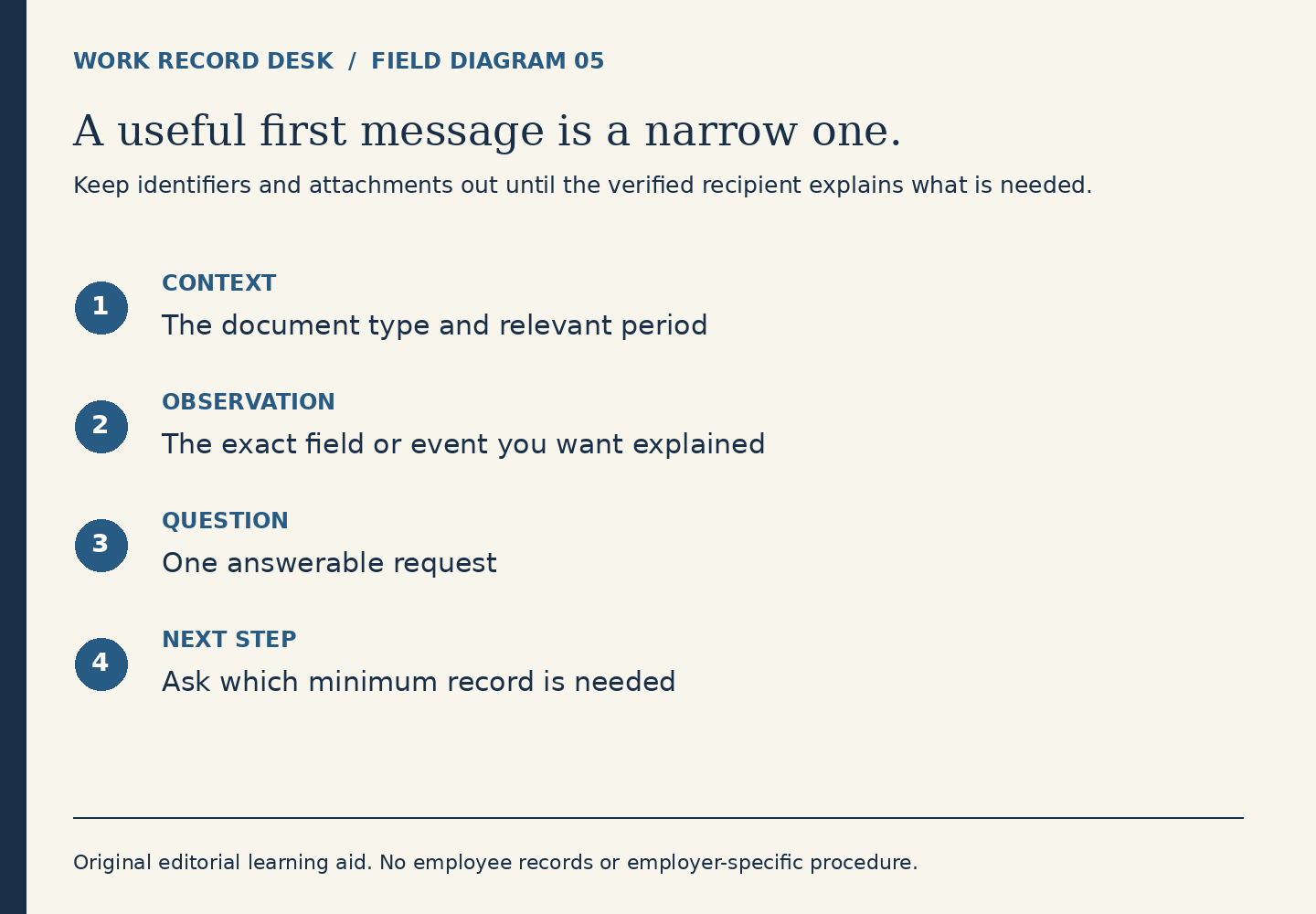
“My pay looks wrong” is a reasonable starting feeling, but a difficult request to investigate. A better first message identifies one payment, one difference and one question. You do not need to solve the entire issue before asking. You do need to distinguish what your records show from what you expected them to show.
The Record Packet Planner can help you choose the preparation steps using broad categories. Keep actual names, dates, amounts and documents in your own private records.
Choose the question before the attachment
Begin with a sentence that names the issue: a missing work date, an unfamiliar earnings label, a deduction you cannot identify, or an adjustment you cannot locate. Then list the covered period and payment date exactly as printed. If you are unsure which record applies, make that uncertainty the question rather than attaching every document you possess.
Victoria’s Secret & Co.’s public associate information page identifies HR Direct as a pay-information resource. Use a current company-approved contact route appropriate to your situation; this guide does not establish a case system, routing rule or response promise. A person’s title or an old forwarded email does not by itself verify the right destination for sensitive documents.
Try a focused fictional request
Riley has a statement covering September 1 through September 14. Their personal log lists seven hours on September 6, while the record they are comparing appears to show five. Riley’s draft says: “Please review the hours recorded for September 6 in the September 1–14 period. My contemporaneous log shows seven hours; the record available to me shows five. Which entry should I use, and is a correction needed?”
That request contains a checkable date and a two-hour difference. It does not call the difference a proven loss before the underlying entries are reviewed. Riley offers the relevant statement and log excerpt through the approved secure method. The message itself does not contain a full Social Security number, bank details or an account password.
Supply enough context, not an entire archive
- Identify the document and its covered period.
- State the displayed value and the value you expected.
- Explain the source of your expectation.
- Ask which record or calculation resolves the difference.
- Retain the sent request and any reference provided.
If the concern involves an unfamiliar deduction, copy its label accurately and ask what it represents. Do not infer a tax treatment or enrollment choice from an abbreviation alone. If it involves a later correction, name the earlier request and ask where the adjustment appears. Separate questions can share one packet when they relate to the same period, but give each its own line.
Make the response usable
A reply such as “processed” may still leave you unsure whether a time entry, payroll calculation or payment changed. Ask for the specific record and effective period needed to confirm the result. Add that answer to your discrepancy chronology. Avoid promising yourself a resolution date unless the authorized source actually supplies one.
The FTC’s identity-protection guidance supports limiting unnecessary exposure of personal information. The packet’s purpose is to make a question answerable while keeping unrelated details private. It is an organizing aid, not a required first step before contacting a labor agency or seeking professional advice when a concern is urgent.