In this article
Separate when work happened, when a record changed and when you learned about it.
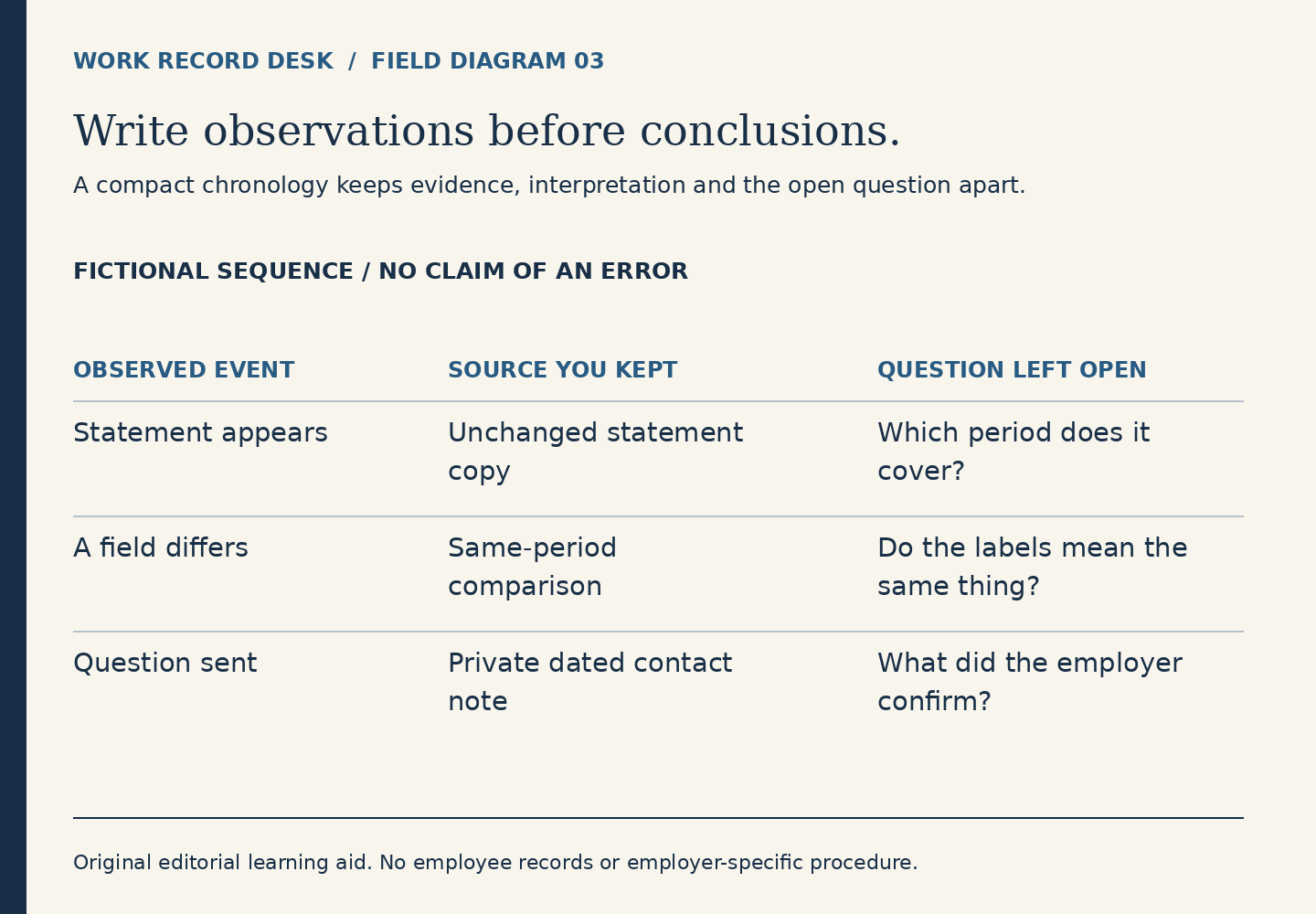
A problem that began with one missing hour can become difficult to explain after three messages, a revised statement and an uncertain phone call. The solution is a short chronology with evidence attached to each entry. It should help another person reconstruct events without having to accept your memory as a complete record.
Use three kinds of dates
Keep the work date, the document date and your observation date separate. For example, an entry about work on September 9 may appear on a statement dated September 25 and first be noticed on September 27. Compressing those into “September 27 pay problem” loses the date needed to find the underlying entry.
Use a separate line for each event. A helpful line says what happened, what source supports it and what remains uncertain. “I wrote six hours in my personal log after the shift” is different from “the employer confirmed six hours.” Both can belong in the chronology, but they have different evidentiary weight.
Follow a correction through the record
In a fictional case, Morgan saves a statement showing 29 regular hours. Their same-period personal log totals 30. On Monday, Morgan sends a question about one specific date. On Wednesday, a reply says the entry is under review. On Friday, a revised record shows 30 hours, but no payment explanation has arrived.
The chronology now has four useful events: original statement saved, question sent, review acknowledged and revision observed. It does not yet support “the correction was paid.” Morgan adds a pending question about where the adjustment appears and which payment includes it. A corrected time record and a completed payment are separate observations.
When a later statement contains an adjustment, Morgan records the displayed label and amount, then checks its relationship to the earlier question. A matching amount can be suggestive without being conclusive. The final note should name the record that connects the adjustment to the original date, or state that confirmation is still needed.
Write facts that survive a handoff
- Use exact dates and document labels rather than “last Friday.”
- Mark recollections as recollections and estimates as estimates.
- Preserve the original message and attachment together.
- Record an unanswered question separately from a confirmed finding.
- Describe a phone conversation as your dated summary unless you have an approved written confirmation.
Keep the tone factual. “The record shows 29; my log shows 30” is more useful at this stage than attributing intent. Neutral language does not minimize a concern. It makes the evidence easier to check and leaves room for an explanation, a correction or further action based on what the records establish.
Know what the chronology cannot do
The DOL’s complaint information identifies pay stubs and personal hours records as useful supporting material. Its older public PDF is a limited source for that point, not a current deadline guide. A chronology does not replace legal advice or pause a filing deadline. Seek timely help if rights or deadlines may be involved.
Close the chronology only when the specific question has an evidenced outcome. Keep any remaining item open, with the next information needed. Store the record using the original-and-working-copy method so a later revision does not erase what you first observed.