In this article
Match the period and pay categories before deciding that two different records disagree.
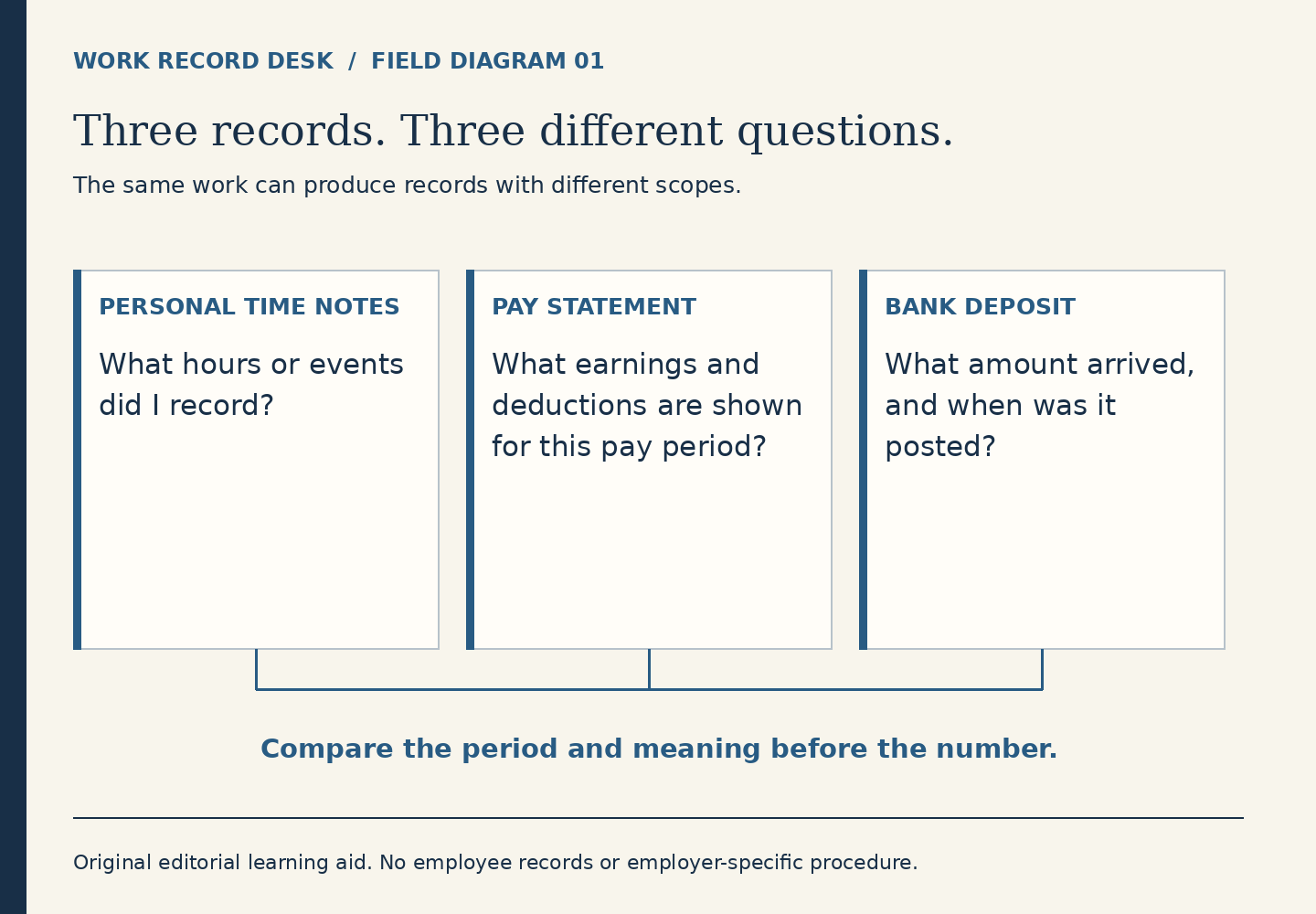
A pay statement and a personal hours log are useful because they answer different questions. One records how a payment was calculated and presented. The other records when you believe work happened. A bank deposit answers a third question: what amount reached a particular account. Treating these as interchangeable makes a small difference harder to explain.
Choose one payment to examine
Start with the payment date and the covered period printed on the statement. Then select only the corresponding dates from your log. Do not compare the latest statement with “the last two weeks” from memory. Your employer’s actual pay period controls the comparison, and this publication does not establish Victoria’s Secret & Co.’s pay schedule.
The Department of Labor’s recordkeeping fact sheet distinguishes daily and weekly hours, pay basis, additions and deductions, and payment-period information for covered nonexempt workers. That framework helps explain why a single total is insufficient. It does not mean every personal pay statement uses the same layout or labels.
Reconcile categories before dollars
In a fictional example, Avery’s log contains 32 hours of actual work. A statement shows 32 regular hours and eight separately labeled paid-leave hours. Avery initially compares the 40 displayed paid hours with the 32 worked hours and suspects duplication. Once the categories are separated, the first question becomes whether those eight leave hours belong to this period and were correctly recorded.
For a deliberately simplified arithmetic check, assume both categories are paid at an invented $18 rate with no premium or other earnings. The regular line is $576; the leave line is $144; their combined gross is $720. A $612 deposit does not establish that six hours disappeared. The $108 difference between gross and deposited pay must be traced through the statement’s deductions and any payment allocation, using actual records.
Now change one fact: the statement lists 30 regular hours while Avery’s contemporaneous log lists 32. The two-hour difference deserves its own review. Locate the specific work dates and any time-entry revisions. Do not let the separate paid-leave line cancel out an unexplained regular-hours difference merely because the final total looks plausible.
Make a small comparison sheet
- Record the statement’s period and payment date exactly.
- List worked hours by date, with the source of each entry.
- Copy earnings labels rather than renaming them from memory.
- Separate current-period amounts from year-to-date amounts.
- Keep uncertain entries marked as questions until verified.
If your log uses hours and minutes, check the units before adding. Seven hours and thirty minutes is 7.5 hours, not 7.30 decimal hours. Conversely, a printed 7.30 may use a display convention that needs explanation. Ask what the format means rather than imposing your own conversion on an unfamiliar report.
Finish with an answerable question
A useful result is “My September 8 log shows six worked hours, while the corresponding record appears to show four. Can you check that date?” Preserve the underlying evidence and use the chronology method if more than one revision is involved. A calculation can locate a question; it cannot independently determine legal entitlement, the correct tax treatment, or the cause of the difference.