In this article
Use three date labels to prevent a payment total from hiding a weekly-hours question.
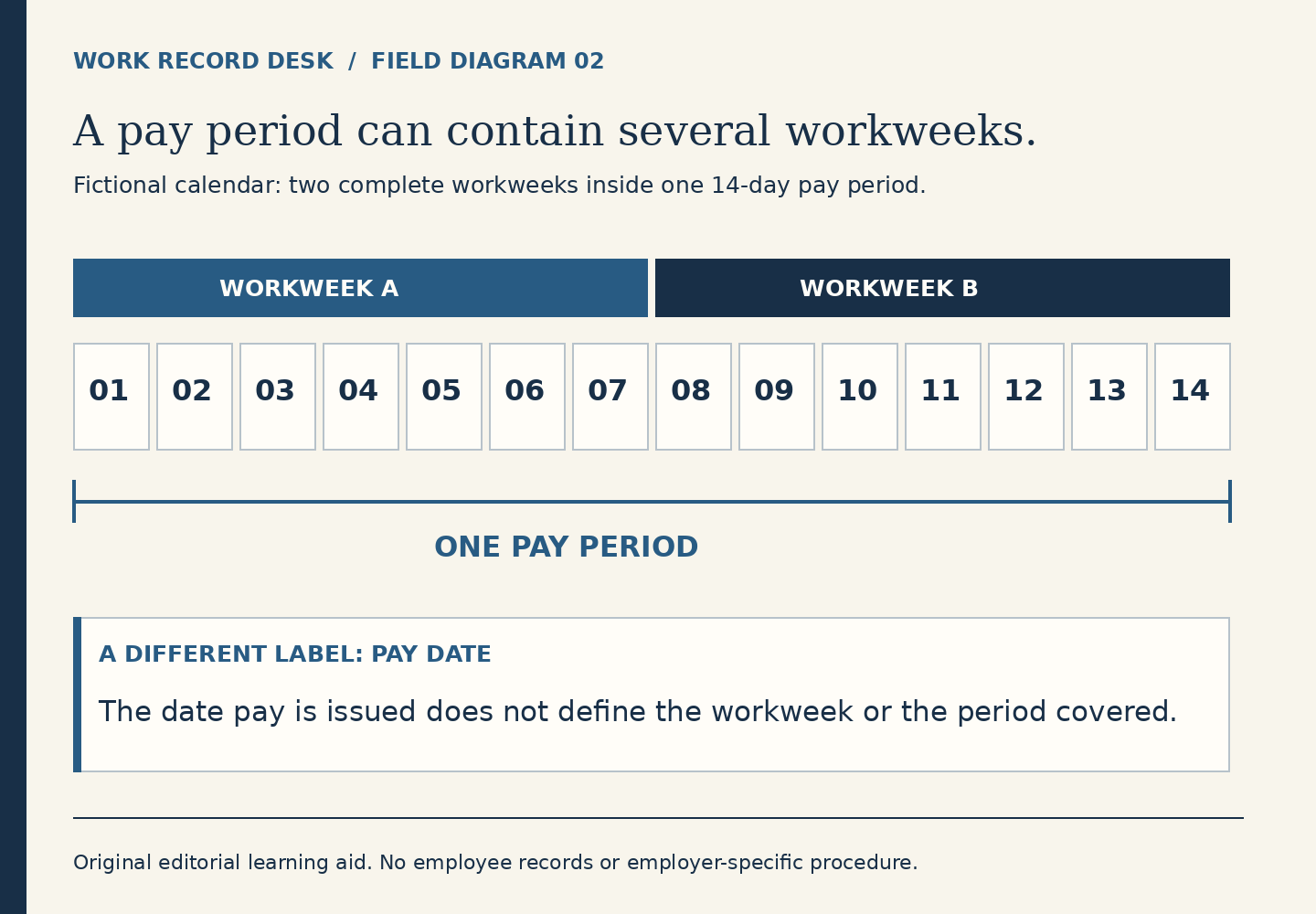
A statement with 80 hours can look straightforward. Yet 40 hours in each of two weeks tells a different story from 46 in one week and 34 in the next. The number on the payment alone cannot tell you which story occurred. First establish the boundaries used to group the work.
Give each date a job
A workweek groups time for weekly analysis. A pay period identifies the interval covered by a payment. A payment date identifies when that payment is issued. Write these on separate lines. A calendar month, a store’s posted schedule and the dates visible on a banking screen may introduce other boundaries; none should silently replace the three you need.
The DOL’s overtime principles describe the federal workweek as a fixed, recurring 168-hour period. For covered nonexempt employees, separate workweeks are not averaged to erase overtime, and pay frequency does not change that weekly framework. This is federal context, not a determination of anyone’s exemption status or a complete explanation of state requirements.
Test a fictional two-week statement
Assume Casey is covered and nonexempt, and that the established workweek runs Monday through Sunday. The first week contains 46 worked hours; the second contains 34. There is no leave, bonus, differential or other complication in this teaching example. The total is 80, but the weekly record contains six hours above 40 in the first week. Averaging to 40 per week would conceal that fact.
Casey’s first task is to preserve the two weekly totals, not immediately to estimate a missing net deposit. The relevant rate and any premium already shown on the statement must also be checked. Some statements separate a premium from straight-time earnings in ways a reader can misunderstand. Ask for an explanation of the actual labels before deciding that a particular display proves an underpayment.
Find the real boundary
Do not copy the Monday start from the example into your own records. A workplace may use another established start day and time. Request or locate the applicable definition through an approved source. If a shift crosses the boundary, retain the start and end times so the hours can be assigned correctly. A guessed weekly grouping can create a discrepancy that disappears when the real grouping is used.
For Victoria’s Secret & Co. associates, this guide supplies no company-specific payroll calendar. Use the dates on your records and current company guidance. If two sources appear to conflict, copy both descriptions into your question and identify where each came from. Avoid silently choosing whichever one gives the expected result.
Build a boundary-first check
- Write the established workweek start day and time.
- Assign each worked interval to the appropriate week.
- Keep paid leave separate from actual worked time.
- Match the statement’s covered period and payment date.
- Flag a week requiring explanation without netting it against another.
The federal recordkeeping overview includes workweek and payment-period information as distinct records. Your own comparison should preserve that distinction. Once the boundaries are confirmed, the payroll question packet helps turn a broad concern into a specific request for review. Seek qualified guidance when the unresolved issue concerns legal rights, classification or a filing deadline.